A powerful line of thunderstorms tore through Washington late Thursday night, unleashing damaging winds, torrential rain and near-continuous lightning that toppled mature trees across the city, crushed cars and left tens of thousands of residents without power.
The storm arrived in the District shortly before midnight after sweeping east through Northern Virginia. At Reagan National Airport, sustained winds reached about 40 mph as the storm passed, with a peak gust of 64 mph at 11:55 p.m., according to the National Weather Service. Visibility at the airport briefly fell to a half-mile in heavy rain.
Across the District, the storm left behind a scattered but extensive trail of damage. City officials estimated Friday morning that roughly 300 trees had fallen in public spaces, some tangled in power lines, as the D.C. Department of Transportation deployed 20 crews to clear streets and sidewalks. D.C. Fire and EMS received 518 calls between 11 p.m. Thursday and 7 a.m. Friday.
Some of the most striking damage was concentrated on Capitol Hill and in Northeast Washington, where streets lined with large, mature trees were littered Friday with broken limbs and entire uprooted trunks.
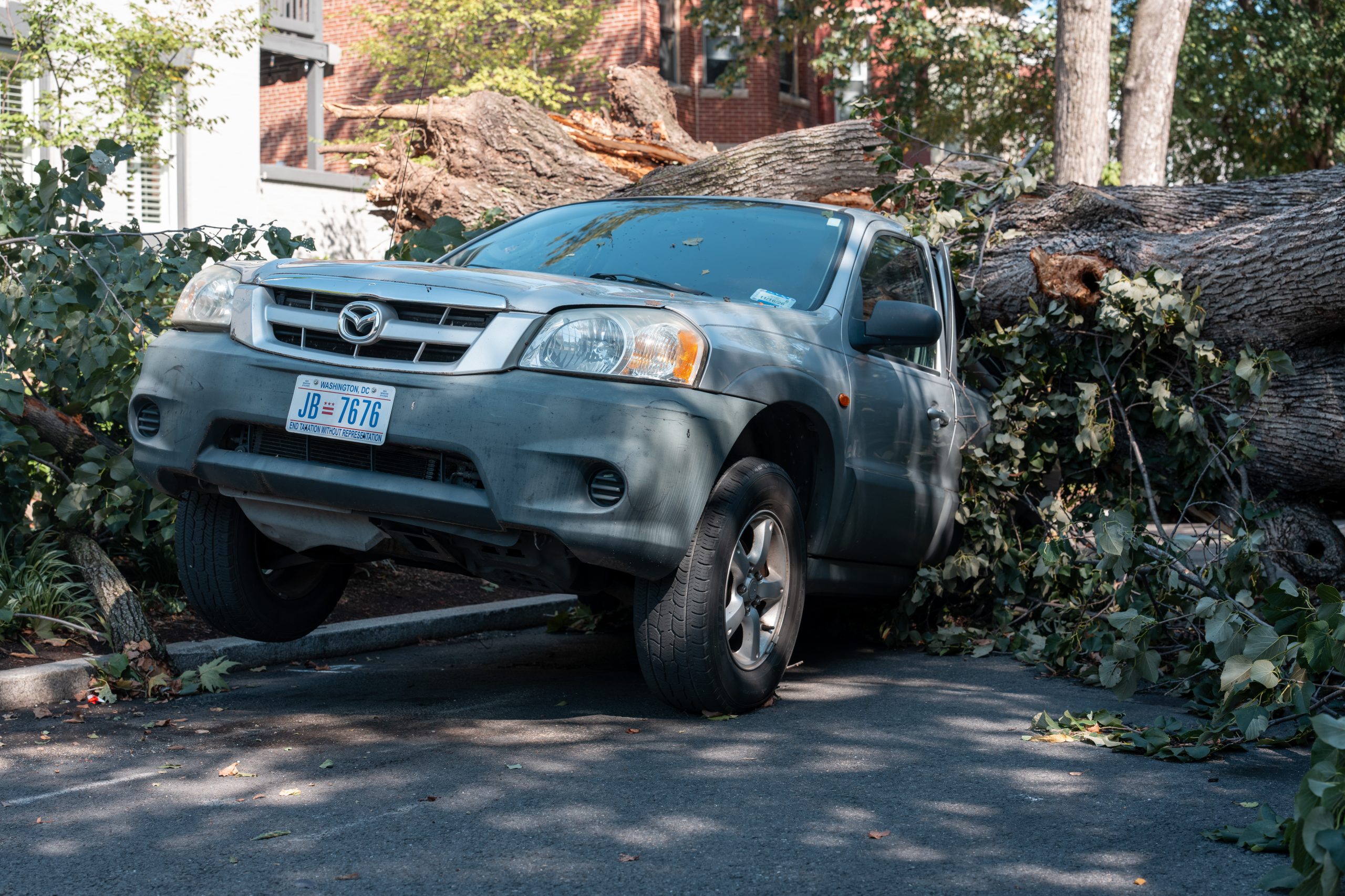
Near Fifth and F streets NE, just northeast of the Capitol, several large trees came down, including one that crushed a parked car and blocked portions of the street and sidewalk. The National Weather Service received reports of dozens of large trees down in the surrounding area.
Farther east, along Maryland Avenue NE near Stanton Park, the storm carved through blocks of mature street trees. Large limbs and entire trees came down along the avenue, including around Eighth Street NE, leaving sections of the neighborhood strewn with branches and debris. Photographs from the area Friday morning showed massive limbs spanning sidewalks and roadways.
The destruction extended beyond Northeast. In Southeast Washington, a large tree fell onto a rowhouse in the 200 block of Eighth Street SE, forcing the occupants to evacuate. No injuries were reported there.
The storm’s winds were strong enough to rival those produced by some of the Washington area’s most memorable summertime thunderstorms. The Weather Service’s observing station at National Airport recorded northwest winds of roughly 40 mph with the 64 mph gust as the heart of the storm crossed the Potomac. A subsequent observation recorded winds of 31 mph gusting to 56 mph, with a peak wind from the northwest of about 55 mph shortly before midnight.
The storm also produced an extraordinary display of lightning as it crossed the region, repeatedly illuminating the sky while heavy rain swept through the city. Meteorologists attributed the storm’s intensity in part to an unusually unstable atmosphere after a hot, humid day, conditions that allowed thunderstorms approaching from the west to remain powerful as they entered the immediate Washington area.
By Friday morning, the scale of the storm was becoming clearer. More than 41,000 Pepco customers in the District and Maryland were without electricity around 9:40 a.m., while tens of thousands more Dominion Energy customers had lost power in Northern Virginia. Prince George’s County Public Schools closed for the day because numerous schools and offices lacked electricity and fallen trees and wires complicated cleanup efforts.
D.C. officials warned residents to stay away from fallen power lines and damaged trees as crews worked through the debris. Some branches weakened during the storm could continue to fall even after the weather had cleared.