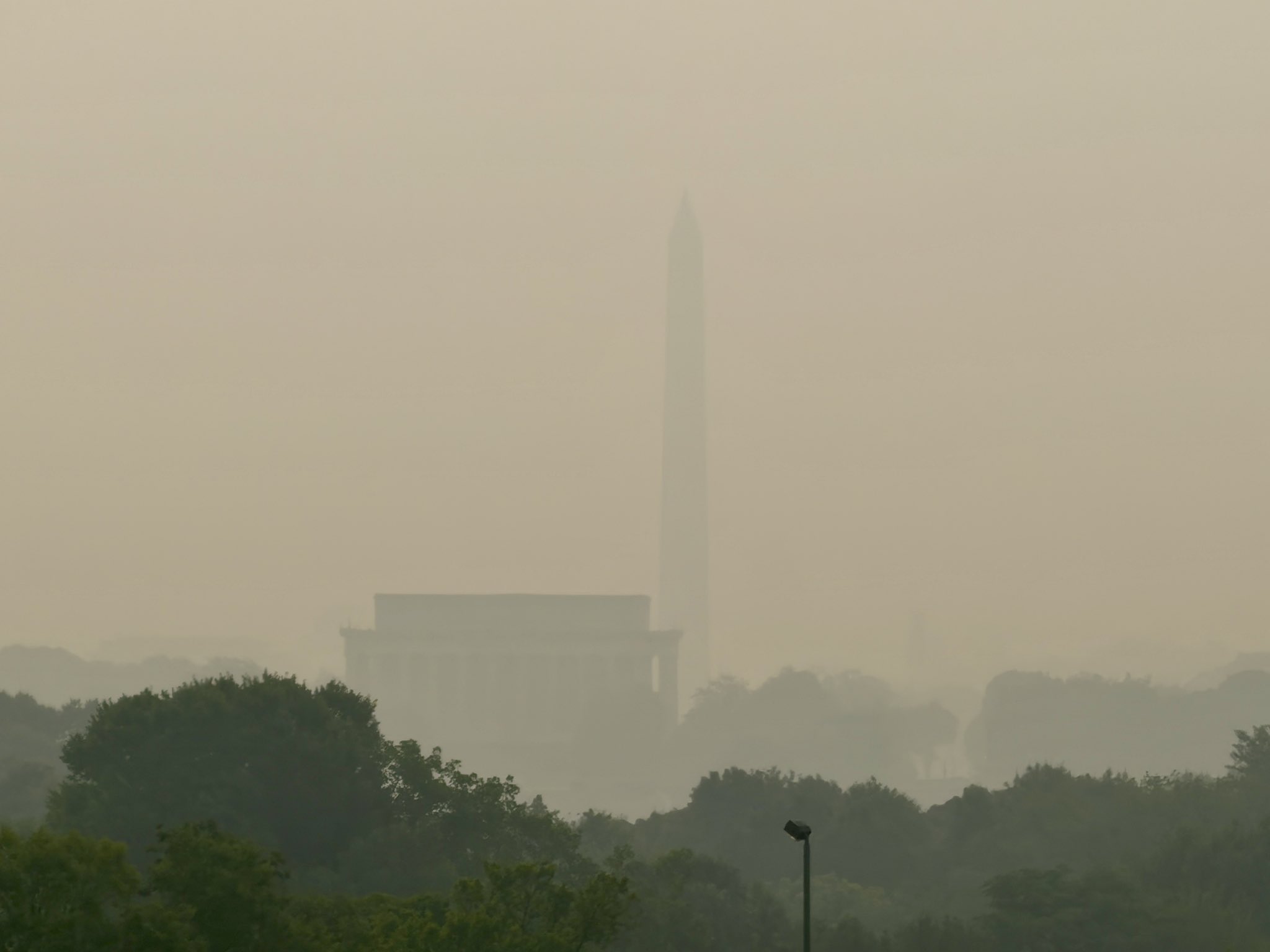
A thick layer of Canadian wildfire smoke continues to hang over the Washington region on Saturday, a day after fine-particle pollution triggered a rare “very unhealthy” Code Purple alert.
The smog, which left a distinct burning smell and a milky haze across the District, prompted the Metropolitan Washington Council of Governments to issue the health advisory as PM2.5 levels surged. These microscopic particles can travel deep into the lungs and enter the bloodstream.
DC Health warned that the smoke could persist through Sunday, though conditions will fluctuate by hour and neighborhood. Residents are urged to check the EPA’s AirNow system before heading outside.
Friday’s Code Purple designation—signaling an Air Quality Index (AQI) between 201 and 300—led to immediate cancellations of outdoor programs at D.C. Public Schools. The D.C. DMV also closed its Half Street SW vehicle inspection station early, granting a five-day extension to motorists with expiring stickers.
While the Air Quality Index ranges from “good” to “hazardous,” health experts emphasize that no level of particulate pollution is entirely safe. Two decades of research shows that both PM10 and PM2.5 particles—the microscopic compounds dominant in wildfire smoke—are linked to increased risks of heart disease, stroke, lung cancer, and premature death, even at low concentrations.
Health officials advise keeping windows closed, setting air conditioners to recirculate indoor air. Standard cloth or dust masks do not filter out PM2.5 particles so officials recommend N95 masks for those working outside. High-risk groups—including children, pregnant women, older adults, and those with heart or lung conditions—should avoid outdoor activity entirely.
Despite warnings, many joggers were seen running in the polluted air around the D.C. region yesterday. When the air is heavily polluted with wildfire smoke, the immediate health costs of a run can exceed the cardiovascular benefits of that workout, according to public health experts.
The smoky blanket underscores how distant wildfires can instantly erase decades of local air quality progress. Driven by cleaner vehicle and power plant emissions, the region recorded just five Code Orange days in 2025, down from 51 unhealthy days in 2005.
Officials cautioned that clearing will depend entirely on shifting wind patterns. Until a clean front arrives, residents are advised to postpone strenuous outdoor activities and rely on real-time data rather than visual cues, as air quality can remain hazardous even when the haze appears to thin.