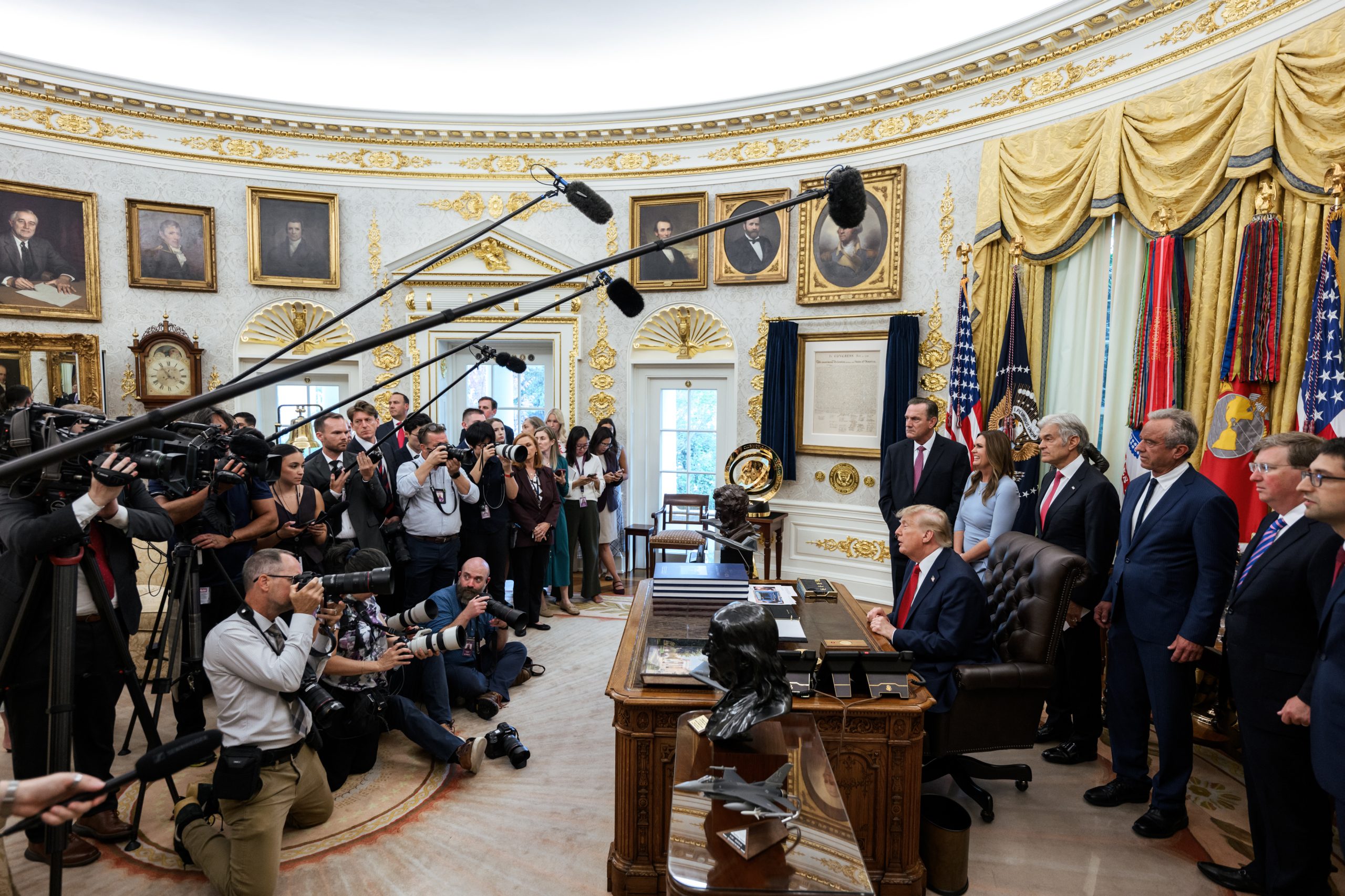
When the president speaks from the Oval Office, boards Air Force One or travels by motorcade, only a fraction of the journalists who cover the White House can follow him.
The reporters, photographers and broadcast crews who do are known collectively as the White House press pool.
The system allows a small group of journalists to cover the president on behalf of the larger press corps when space, security or logistics make broader access impractical. The pool follows the president at the White House and on the road, providing written accounts, photographs, video and audio to news organizations around the world.
The arrangement has drawn renewed attention this week after the five television networks that traditionally rotate responsibility for television pool coverage — ABC, CBS, CNN, Fox News and NBC — suspended their participation. The decision came after the Trump administration barred CNN, MS NOW and Politico from the White House and prevented CNN from performing its scheduled pool duties.
The television pool is only one part of a larger system. Print reporters, still photographers, radio correspondents and wire-service reporters have separate roles, and most of those operations have continued.
Here is how the pool works.
The print pool reporter serves as the primary written eyewitness for the broader press corps.
When the president holds an event in a space too small to accommodate all reporters, the print pooler attends and sends written dispatches known as pool reports. They can include the president’s remarks, answers to shouted questions, descriptions of the scene and details about who was present.
The reports are distributed rapidly to other journalists, who may use the information in their own coverage. The White House Correspondents’ Association instructs print poolers to file quickly and factually and to give the pool priority over their own publication while on duty.
Some reports are consequential. Others simply document the president’s movements: when the motorcade departed, when Air Force One landed or when the White House declared a “lid,” signaling that no further public events are expected that day.
Television
Television networks have traditionally shared the considerable expense and logistical burden of maintaining a camera crew close to the president.
ABC, CBS, CNN, Fox News and NBC rotate responsibility for providing the television pool. The network assigned on a particular day supplies the camera crew and distributes its video to the other participating networks.
That arrangement explains why different television networks frequently show identical footage from an Oval Office meeting or another restricted event: They are using the same pool camera.
The television pool is currently suspended.
CNN was scheduled to provide the pool Monday but was prevented from doing so after the White House revoked access for CNN, MS NOW and Politico. The other networks declined to replace CNN, and the five networks stopped providing television pool coverage of presidential events.
The suspension does not prevent networks from covering events where their own crews are admitted. But at events restricted to the presidential pool, the usual shared television camera and audio equipment are absent.
The effect was apparent Monday when Trump spoke near the new White House helipad. Video was available from another source, but without the normal pool audio equipment, his comments were difficult to hear over the noise of Marine One.
Still photography
Still photographers form another component of the pool.
At an in-town presidential event, the traditional pool includes photographers representing the Associated Press, Reuters, Agence France-Presse, a newspaper and a photo agency. On Air Force One, four of the 13 traditional press seats are allocated to photographers.
Their job is to independently document events that most photographers cannot enter. At an Oval Office meeting, for example, only a small number of photographers may be admitted even though scores of news organizations want photographs.
Those images are then distributed by wire services and other participating organizations and can appear in newspapers and on websites around the world.
Still photographers have also participated in the current protest over White House access, although their action has differed from the television pool’s suspension. Several organizations temporarily withheld pooled photographs from publication or distribution Monday. Print, radio and wire coverage continued.
Radio
Radio has its own position in the presidential pool.
The radio pool provides audio and a correspondent who can report on events for participating broadcasters. A radio correspondent is also part of the traditional traveling pool aboard Air Force One.
The role can be particularly important when television cameras are not present. Broadcast-quality audio allows radio stations — and, in some circumstances, other journalists — to hear precisely what the president said.
Wire services
Wire-service reporters are among the journalists who remain closest to the president.
AP, Reuters and Bloomberg traditionally provide reporters for the in-town and traveling pools. Unlike the rotating print position, wire reporters have dedicated places because their reports are distributed immediately to large numbers of news organizations.
The distinction between wires and the print pool can be confusing. Both produce written journalism, but the designated print pooler is explicitly responsible for filing reports for the entire press corps. Wire reporters primarily report for their own services and subscribers.
What happens when the president travels?
The pool travels with him.
For trips around Washington, journalists ride in press vans within the presidential motorcade. The traditional in-town pool includes print and wire reporters, photographers, radio and a network television crew.
For trips outside the Washington area, a smaller group travels with the president. Air Force One traditionally has 13 pool seats: three wire reporters, four photographers, three television representatives, a radio correspondent and two print reporters. News organizations generally pay the costs associated with their journalists’ travel.
The arrangement ensures that journalists remain near the president even when no public event is scheduled. A pool may spend hours waiting without producing significant news. Its value becomes apparent when something unexpected happens.
What is a pool spray?
A “pool spray” is a brief period when the pool is brought into an otherwise private event.
During a meeting with a foreign leader, for example, journalists may be allowed into the Oval Office for several minutes. Photographers take pictures, the television crew records video, and reporters listen to opening remarks and shout questions.
The journalists are then escorted out while the meeting continues privately.
Those few minutes can produce much of the independent reporting, photography and video the public sees from the meeting.
The pool and the press corps are not the same thing
The White House press corps consists of the much larger group of journalists who regularly cover the president and the administration.
The pool is the smaller group given access when everyone cannot be accommodated.
Its composition changes depending on the event. A typical White House pool can include about 20 correspondents, photographers and technicians, while the group traveling aboard Air Force One is considerably smaller.
The system rests on a simple principle: A room may not be large enough for every journalist who wants to cover the president, but independent journalists should still be there to document what happens.
That is why a presidential appearance can simultaneously produce a written pool report, photographs from several news agencies, broadcast-quality audio and television footage from a single camera.
They are different parts of the same system — a small group of journalists acting as the eyes and ears of a much larger press corps.