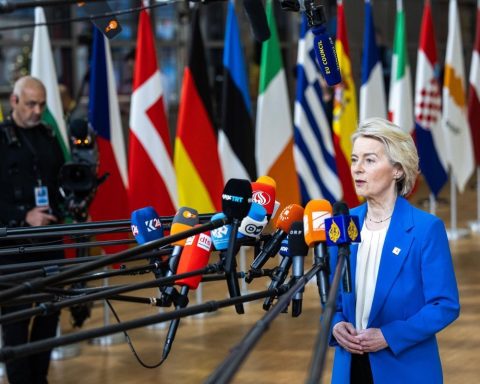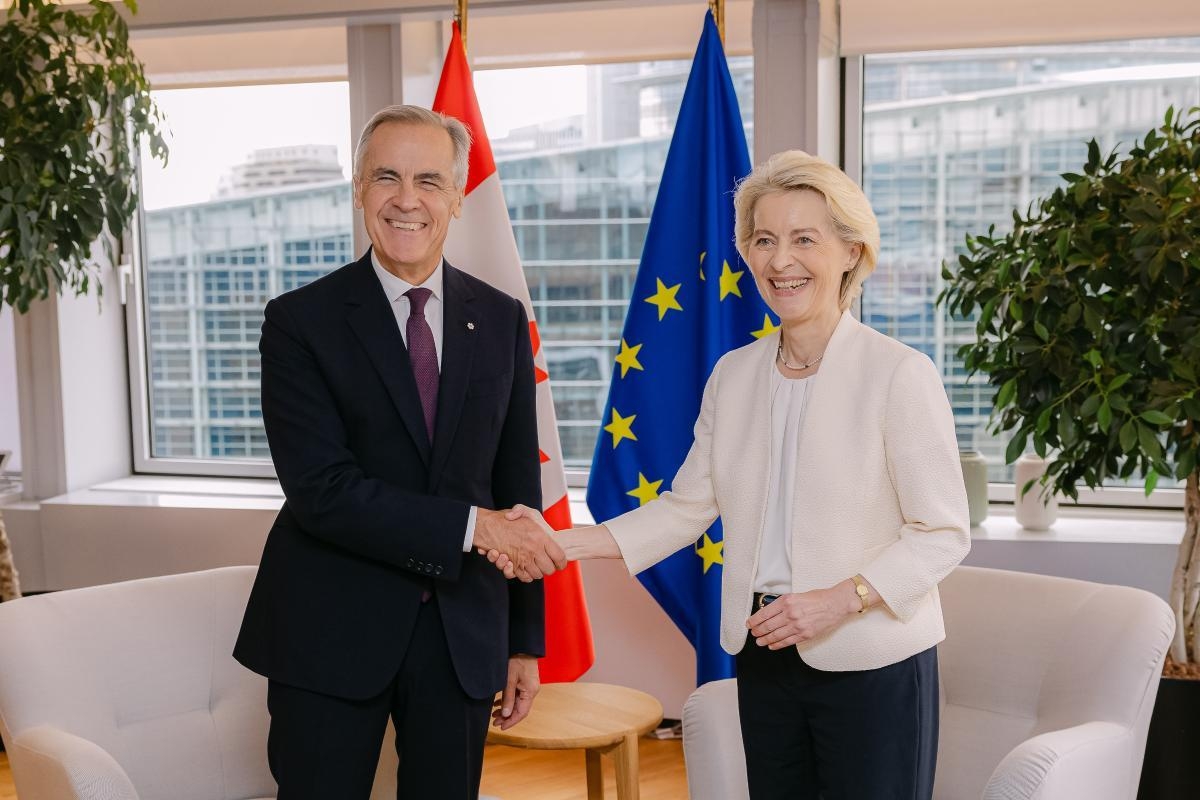
STRASBOURG, France — European Commission President Ursula von der Leyen called Wednesday for slowing the race to build the world’s most powerful artificial intelligence systems and proposed making Canada the European Union’s first “associate member,” two of the most significant announcements in an annual address.
Speaking before the European Parliament with Canadian Prime Minister Mark Carney in attendance, von der Leyen said Europe must become more capable of acting independently while strengthening relationships with countries that share its interests.
Her most striking proposal was an invitation for Canada to establish a new relationship with the 27-nation bloc. Von der Leyen said the European Union should open the door for Canada to become its first associate member, a status that does not currently exist in EU treaties and whose precise terms would have to be negotiated.
The proposal could deepen cooperation between Canada and Europe in areas including trade, defense, energy, critical minerals, technology and the Arctic.
“We see the world with the same eyes,” von der Leyen said of Canada, arguing that like-minded countries need to draw closer in what she described as an “openly hostile world.”
EU lawmakers gave the proposal a standing ovation, and von der Leyen walked across the chamber to embrace Carney.
Von der Leyen also devoted a significant portion of the address to artificial intelligence, warning that the rapid development of increasingly powerful models could bring profound benefits while creating new security risks.
She endorsed efforts to “pace the frontier” — slowing the development of the most advanced AI systems to allow more time to understand and control their capabilities. She warned that future models could dramatically increase the ability of malicious actors to conduct cyberattacks and cause other forms of disruption.
Europe, she said, would seek to work with AI companies and international partners rather than act alone. She proposed closer cooperation with Canada, Britain and other countries on testing advanced models, identifying emerging threats and developing common safety standards.
At the same time, von der Leyen argued that Europe should not retreat from AI development. She highlighted potential applications in science, industry and medicine, saying AI could help doctors diagnose disease while insisting that technology should support rather than replace physicians.
The speech also reaffirmed Europe’s support for Ukraine as Russia’s war continues. Von der Leyen pledged continued humanitarian and military assistance and called for maintaining pressure on Moscow. EU countries have agreed to provide an additional 90 billion euros for Ukraine’s military and budgetary needs in 2026 and 2027, while Kyiv’s negotiations to eventually join the European Union have advanced this year.
Security was a broader theme throughout the address. Von der Leyen proposed creating a European Security Council and an emergency protocol intended to allow Europe and close partners to respond more rapidly to crises, including cyberattacks, sabotage and drone incursions.
Other proposals included tougher measures governing children’s access to social media, a new European framework for responding to large-scale migration emergencies, a plan to secure supplies of critical raw materials and new measures to prepare for heat waves and wildfires.
But Canada and AI provided the clearest examples of the larger argument running through the speech.
Von der Leyen portrayed Europe as confronting technological and geopolitical changes that individual European countries cannot manage on their own. Her answer was a more independent Europe — but one increasingly linked to a wider group of democratic partners.
“The state of our Union is the strongest it has ever been,” she said. “The state of our Union can also feel as precarious as it has ever been.”